
Sync-codes
A sync-code is a bookmark at a specific timestamp (or timecode) in the timeline that can be associated with a specific line in the transcript. Once sync-codes are manually added, this allows a user to quickly locate and playback specific lines in the transcript.
Watch the basic and advanced video tutorials on YouTube.
Entering and modifying sync-codes
With v2.0, two types of sync-codes can be added to synchronise lines of the transcript to the chronological timeline: punctual and ranged sync-codes.
Punctual sync-codes
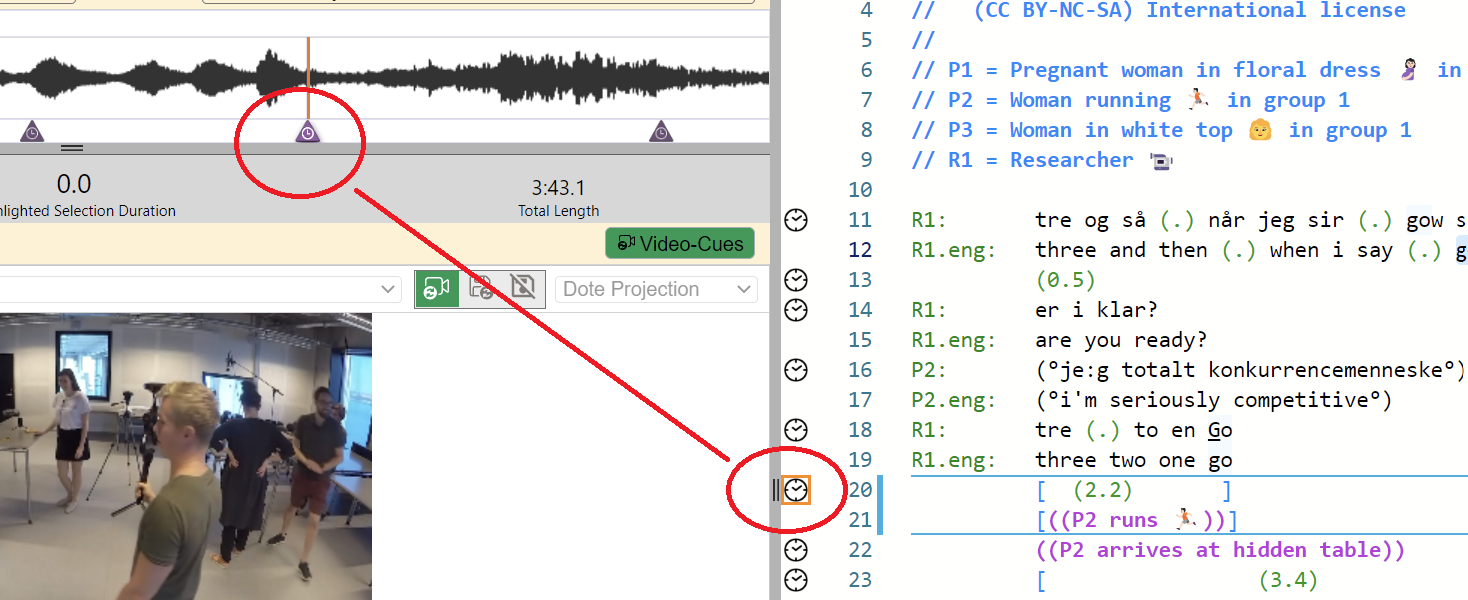
This type of sync-code synchronises a line to one timestamp. It has no duration. A punctual sync-code is indicated on the Timeline by a purple triangle (see above image).
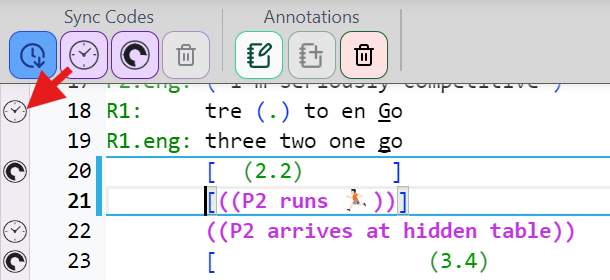
- Play the video and pause at the point to be sync-coded. Enter a punctual sync-code by clicking on the clock that appears when you move the mouse cursor over the space before the line number on the line desired in the transcript panel. Sync-codes can be added using the shortcut CTRL+M or ⌘+M on the current line.
- You can drag the sync-code in the transcript editor to a new line between adjacent sync-codes.
- You can drag the sync-code in the timeline to a new position (timecode) between adjacent sync-codes.
- A selected sync-code can be nudged on the timeline by a small increment using the shortcuts CTRL+H or ⌘+H for a backwards nudge and CTRL+L or ⌘+L for a forwards nudge.
- Sync-codes can be deleted. Select the sync-code, right click, and choose delete. Or select the line which the sync-code links. Press the delete sync-code button at the top left of the Transcript Editor or the left side of the Timeline (in purple).
Ranged sync-codes
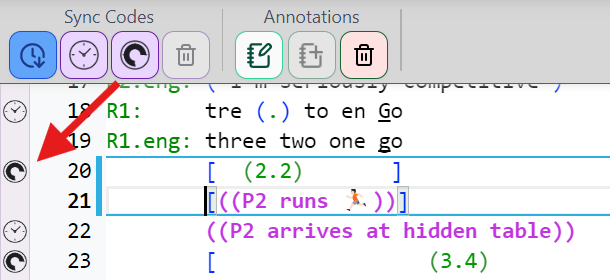
This type of sync-code synchronises a line to start at one timestamp and end at another. It has duration. A ranged sync-code synchronises a line to a time segment with duration, ie. it has a start and an end point. It is indicated in the Editor and the Timeline by a special icon (not a clock). It shows the duration with a purple line between two anchor points at the bottom of the Timeline (if sync-code mode is toggled on).
- Play the video and pause at the point to start the ranged sync-code.
- Press SHIFT and drag along the Timeline to create a selection.
- Click on a line in the Transcript Editor that is to be synced.
- Enter a ranged sync-code by clicking on the ranged sync-code button at the top left of the Transcript Editor or the left of the Timeline panel. Sync-codes can be added using the shortcut CTRL+SHIFT+M or ⌘+SHIFT+M on the current line.
- You can drag each ranged sync-code in the transcript editor to a new line between adjacent sync-codes.
- You can drag each end of the ranged sync-code in the timeline to a new position (timecode) between adjacent sync-codes.
- A selected ranged sync-code can be nudged on the timeline by a small increment using the shortcuts CTRL+H or ⌘+H for a backwards nudge and CTRL+L or ⌘+L for a forwards nudge.
- Ranged sync-codes can be deleted. Select the ranged sync-code, right click, and choose delete. Or select the line which the sync-code links. Press the delete sync-code button at the top left of the Transcript Editor or the left side of the Timeline (in purple).
Turning on CS Mode to synchronise the Transcript with the Media during playback
Unless CS Mode (show highlight of current sync-code block) is turned on, the Editor will not automatically highlight the currently relevant block of transcript lines during playback.
You can turn on CS Mode mode by clicking the button at the top left of the Editor to enable the current sync-code block to be highlighted as you play the media.

Notes
- If you delete whole lines that have sync-codes attached, then those sync-codes will also be deleted.
- Please note that edits to sync-codes are tracked by DOTE. For instance, if you move a sync-code to a different line or to another position on the timeline, then you can undo those actions with the Undo/Redo function, but not with the standard shortcuts. Moreover, sync-codes are tracked by Checkpoints and Autobackups, so if you revert to an earlier Checkpoint or Autobackup, then the sync-codes will be restored as well.
- Also note that copying a line in the editor which has a sync-code and pasting the line does not copy the original sync-code to the new location.